


Summary
- Aldi Taher, an Indonesian entertainer and public figure whose unconventional posts have made his burger business highly visible online. His marketing breaks the usual rules: he uses random celebrity references, irrelevant captions, and even recommends competitors. Instead of weakening the brand, this makes his content feel surprising, funny, and highly shareable.
- The bigger lesson is that absurdity can work when it feels authentic and harmless. But brands should not copy the randomness; they need to understand the psychology behind why audiences pay attention, laugh, and share.
The Psychology of Absurd Marketing: Why Aldi Taher Keeps Going Viral
Incorporating absurdity into marketing content often succeeds in gaining traction amid an abundance of ‘conventional’ content; and hence help to build mental availability for the brand. One of the recent phenomena widely discussed is Aldi Taher, an Indonesian entertainer who has recently become the subject of widespread public attention for his seemingly nonsensical yet oddly amusing remarks. Despite often sounding irrational, his comments continue to entertain audiences, spark conversations, and remain memorable. His peculiar way of promoting his business, Aldi’s Burger, lingers in people’s minds, attracts engagement, and even encourages people to try the products he promotes.
Traditionally, brand communication tends to emphasise product strengths, create urgency to purchase, and avoid promoting competitors at all costs. However, these conventional marketing strategies are challenged by Aldi Taher.
One of his most widely discussed promotional posts on Threads featured burger advertisements filled with irrelevant celebrity names and song lyrics that have nothing to do with the product itself. Not only that, Aldi even promotes other businesses when a consumer comes outside of operating hours instead of persuading them to return another time. In conventional marketing logic, this behaviour should weaken brand positioning.
(The phrase "Juicy Luicy Mahalini Rizky Febian" is intentionally absurd. It references the band Juicy Luicy, singer Mahalini, and singer Rizky Febian as a joke rather than describing the burger). (link)
What Aldi Taher creates is a form of cognitive dissonance.
The Psychology Behind Cognitive Dissonance – but what actually is it?
Cognitive dissonance refers to a psychological state where individuals experience mental discomfort after encountering information or situations that contradict their existing mental models. According to Festinger’s theory of cognitive dissonance, the human mind is naturally driven to resolve this discomfort by rejecting the dissonant information or by restructuring its beliefs to accommodate it. Because resolving dissonance requires mental effort, cognitive dissonance is often avoided.
Logically, when a businessman promotes their products the unconventional way Aldi Taher does (i.e., irrelevant marketing message or promoting competitors), our brains should reject the behaviour because it contradicts the common expectations we have toward business owners. Yet people do not reject it. In fact, many people find it entertaining, memorable, and oddly compelling.
This might spark questions: what makes it widely acceptable?
The Pattern Interrupt
People are exposed to numerous advertising messages daily. The brain, operating under significant cognitive load, results it to develop an efficient filtering system: it learns to recognize and ignore repetitive stimuli. As a result, people become highly accustomed to benefit-driven promotional content, to the point where much of it becomes functionally invisible to the attention system.
Aldi Taher’s content functions as an anomaly, and that is why it captures attention. Human attentional systems are specifically tuned to detect novelty and incongruity. The brain cannot easily ignore something that deviates significantly from familiar patterns. The result is involuntary attention: the kind that does not require a media budget to purchase; and yet builds the brand’s mental availability in the consumer’s minds.
Radical Authenticity as a Trust Signal
There is a counterintuitive dynamic at work in how Aldi Taher's audience responds to his content. When he recommends a competitor, people do not think less of his product. They think more of him.

Translation:
- "I used to think Aldi Taher was tacky and annoying, but it turns out he's been building an out-of-the-box personal brand and this is just the Aldi Taher way. Not every celebrity or influencer could pull this off. Wishing you continued success, bro. Looking forward to your opening a branch in Bandung". (link)
- "Only Aldi Taher could promote something like this and make it go viral. If it were anyone else, the vibe would probably be pretty ordinary". (link)
- "Aldi's burgers have soft buns and meat that's Juicy Luicy, Mahalini, Rizky Febian. I do not want to buy it online!!!! You should already open a store in South Jakarta." (link)
This is, in part, the logic of the halo effect operating in reverse. Positive associations with a communicator transfer to their message. But what Aldi Taher demonstrates is something more nuanced: the absence of a hidden agenda is itself a powerful trust signal. If he is willing to be honest about competition, the reasoning goes, he must be telling the truth about everything else.
Memetic Shareability
Lastly, going beyond disrupting patterns and indirectly gaining trust, Aldi’s content encourages participation. People repost it, turn it into memes, quote it, recreate it, and circulate it across platforms.
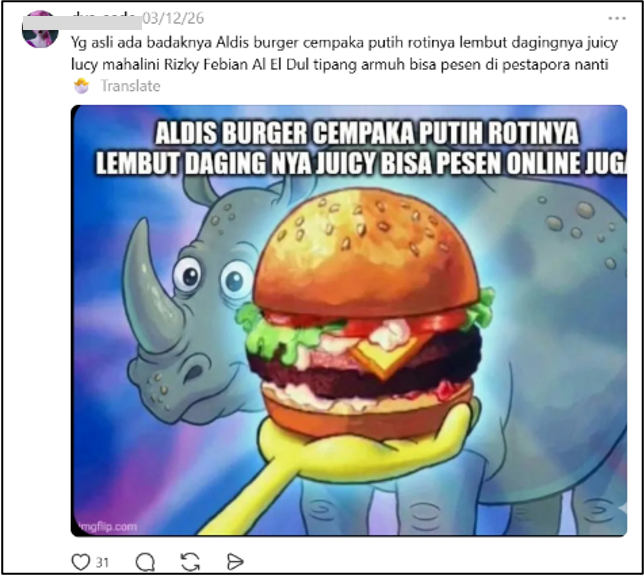

Translation:
- The original one has a rhinoceros (this phrase is already a well-known meme). Aldis Burger Cempaka Putih, the bun is soft, the meat is Juicy Luicy Mahalini Rizky Febian Al El Dul Tipang Armuh, you can order it at Pestapora (a local music festival) later. (In the picture: "Aldis Burger Cempaka Putih, the bun is soft, the meat is juicy. You can order online too.") (left - link)
- I don’t know what I’ll ever use it for, but Alhamdulillah, I’ve already memorised it. (right – link)
Lastly, going beyond disrupting patterns and indirectly gaining trust, Aldi’s content encourages participation. People repost it, turn it into memes, quote it, recreate it, and circulate it across platforms.
From a psychological perspective, several theories help explain why this happens.
1. Benign Violation Theory - Peter McGraw and Caleb Warren propose that humour emerges when two conditions occur simultaneously: something must violate norms or expectations, while also remaining harmless enough to feel safe. Both conditions are necessary. A violation that lacks harmlessness is simply threatening. Without an element of violation, something may be pleasant, but it remains unremarkable. Humour exists in the narrow space where both conditions overlap.
Aldi Taher unintentionally succeeds in meeting both requirements. His promotional style clearly violates social expectations surrounding marketing communication. He promotes competitors, inserts irrelevant references into advertisements, and disregards the polished professionalism people normally expect from business owners.
Yet these violations remain benign. No one is harmed. No one is deceived. The worst that happens is that a confused audience or a competitor gets an unsolicited endorsement. The result is humour — and crucially, that humour attaches itself to Aldi Taher as its source. Audiences do not just find the content funny; they find him funny, which creates a much stronger and more lasting impression.
2. Incongruity-Resolution Theory - Suls' Incongruity-Resolution Theory approaches humour from a cognitive rather than a moral angle. The theory proposes that the experience of humour is essentially the experience of resolving an unexpected incongruity, and that this resolution produces genuine cognitive pleasure.
We, as humans, tend to form expectations about how situations are supposed to unfold. Again, Aldi’s antics and statement violate that expectation in a way that is initially baffling. People then subconsciously work to resolve that confusion by searching for an interpretation that makes the behaviour coherent. Once that interpretation is found, the brain experiences a small sense of reward.
For example, when Aldi recommends his competitor, people are briefly in the position of genuine confusion: why would a seller do this? But then comes the resolution; Aldi is simply being himself, consistently expressing his unfiltered thoughts. The act of making sense of his behaviour can be inherently rewarding, adding to its appeal.
The Risk of Manufactured Absurdity
Recently, many brands, especially on platforms like TikTok, have attempted to recreate this style of absurdity through staged content designed to appear unconventional. However, not all of these attempts succeed.
One example involves a baby care product advertisement portraying a woman becoming visibly irritated by a crying baby and scolding the child’s mother while she tries to calm the baby down. Instead of perceiving the content as humorous, people react negatively because the scenario feels lacking in empathy.

Translation: Babyzilla? A neighbour got angry because a baby kept crying and making too much noise. (link)
This demonstrated that violating common norms must still be approached carefully. When a violation creates emotional harm or feels genuinely hostile rather than benign, the result is backlash instead of humour. Breaking expectations alone is not enough. The key lies in understanding the nature of the violation itself. Does it remain harmless enough to be perceived as playful and humorous? Or does it cross the line into discomfort, cruelty, or insensitivity?
Absurdity can be a powerful marketing tool precisely because it disrupts predictability. But when brands attempt to break patterns without understanding the psychological boundaries that make those violations acceptable, the strategy can quickly become counterproductive.
At Illuminate Asia, we believe successful marketing is not about copying what went viral, but understanding why it resonated in the first place. By combining behavioural science with deep cultural insight, we help brands identify the psychological and social forces that shape how people pay attention, make sense of brands, and ultimately choose what to engage with.
To explore how these behavioural insights can inform your brand strategy across Asia, get in touch with us at info@illuminateasia.com.
FAQs
1. Why does absurd or unconventional marketing attract attention? Absurd marketing disrupts the patterns audiences are already familiar with. Since people are constantly exposed to repetitive promotional content, the brain naturally filters much of it out. Unpredictable or unconventional content stands out because it breaks those expectations and triggers curiosity.
2. What is cognitive dissonance in the context of marketing? Cognitive dissonance refers to the mental discomfort people experience when encountering something that contradicts their expectations or existing beliefs. In marketing, unconventional content can create this tension, encouraging audiences to pay closer attention as they subconsciously try to make sense of the inconsistency.
3. Why do people find Aldi Taher’s marketing style entertaining instead of confusing? Although his content often feels random or contradictory, audiences generally perceive it as harmless and humorous rather than threatening. The absurdity creates surprise, while the lack of harmful intent makes the content feel playful and memorable.
4. What is Benign Violation Theory? Benign Violation Theory suggests that humour happens when something breaks social norms or expectations while still feeling safe or harmless. If a violation feels too aggressive or offensive, people react negatively instead of finding it funny.
5. Why do some “absurd” marketing campaigns fail? Not all unconventional content succeeds because audiences also evaluate the emotional impact behind the behaviour. If the content feels insensitive, harmful, or lacking empathy, people may perceive the violation as uncomfortable rather than entertaining, which can lead to backlash instead of engagement.
6. Does this mean all brands should use absurdity in their marketing? Not necessarily. Absurdity is effective when it aligns with audience perception and remains socially acceptable. The goal is not simply to be random, but to create unexpected moments that still feel relatable, harmless, and emotionally understandable to audiences.
References: