

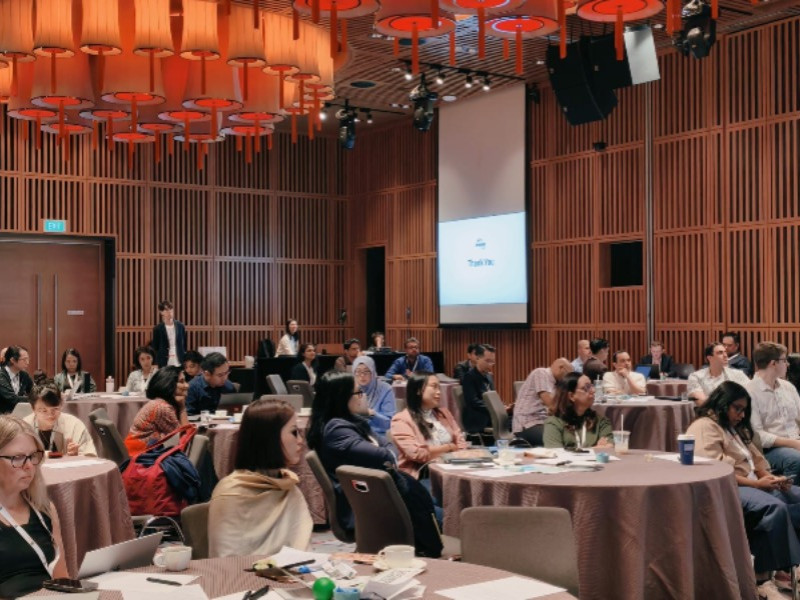
I just spent two days at Qual 360 conference in Singapore with client-side insight teams, agency researchers and a fair few restech (AI) platforms. The opening question of the conference set the tone for both days: what do we keep, and what do we let go of? A second question kept coming back too: whose voice is missing?
Here are some of my key reflections from the discussions and presentations from the 2 days..
The AI debate has moved on - Nobody in the room was asking whether AI belongs in qual anymore. That argument is over. The questions now are practical: where does it help, where does it hurt, and who decides?
There was enthusiasm for AI-moderated interviews: broader reach, faster turnaround, more flexibility. One speaker made a strong point: people often open up more to an AI moderator on sensitive topics.
But Google’s Yashan Cama gave the room a useful check early on, and stuck across the sessions. Speed and rigour are not the same thing. Before designing a study, ask the client team which matters more this time. The panel on Day 1 pushed it further: start with the business question, not the method. Qual at scale is one tool for certain questions, not the answer to everything.
The questions that didn’t get easy answers - The final panel was the most honest session for me. If AI has brought the cost of qual down, why aren’t we doing more of it? How else do you make sense of all the data? The best moments in qual still come from micro-observations: a hesitation, a workaround, a look. Can qual at scale really catch those?
There were frank admissions too. Questioning has got weaker, clients are seeing fewer projective techniques. Results can feel generic, and respondent quality is a growing worry. Nobody had a neat fix.
Our job is changing shape – The Cathay Pacific team (Ernest Hui and Kenneth Law) talked about researchers moving from producers to influencers, and that idea ran through the whole second day. Joy Lee from DBS described research as a risk advisor that needs to be in the room from day one. Bosch Home Comfort’s Diyana Syafiqah reminded us that an insight can be understood, agreed with, and still go nowhere.
There was also a candid discussion about our clients. If they’re sold on AI, our role is to show where the human judgement sits. If they’re sceptical, our role is to educate. Either way, the job is explaining the trade-off between speed and rigour in plain language.
Going deeper, not just faster - Some of the most memorable work was unapologetically human. Priyanka Bhargav spoke of her experience at FlipKart where she ran a Shark Tank-style co-creation days with HR, finance and supply chain in the room. enu Singh described how PepsiCo team sent its leaders shopping on a real household budget with “Shop Like Me”. One panellist made a point that matters a lot for our region: young people in different countries are often more alike than young and old people in the same country. Simple segments don’t hold anymore.
What I’m taking home - In Southeast Asia, where markets and generations differ so much, I think the case for human insight is getting stronger, not weaker. We’ll keep using AI for the parts that should be fast. And we’ll keep protecting the time to sit with people, watch closely and help clients act on what we see.
The question I’m still chewing on is the one the conference closed with: will the human skills last, and will we be able to show clients why they matter?
Let’s keep the conversation going
If any of these questions are on your agenda, our team in Jakarta and Singapore would love to chat. Get in touch at info@illuminateasia.com.